
I am referring to this year’s festival’s minority offering of ‘slow cinema’. That is: cinema in which not a lot of dramatic stuff happens and in which you aren’t led by the nose through extreme, artificial emotional hoops by contorted plots and hyperbolic music. In slow cinema you come to contemplate the rhythms of cinema itself … and perhaps even glimpse something behind the art that syncs with your ground-zero experience of living in this world.
Long takes, not much narrative, not a lot of dialogue … simply places and spaces and people and simple actions … this is cinema made in a silent way … ssshh!
Of course, this is not always the case: the films of Lav Diaz and Bela Tarr are often filled with violence of one sort or another. But I found the following films calmed me down and lifted my spirit – which is exactly what a lot of us need right now.
Slow cinema strikes me as relating to both ‘naturalism’ and ‘formalism’. Two of my favourite films at this year’s festival each addressed one of these strands.
Sompot Chidgasornpongse’s 9 Temples to Heaven
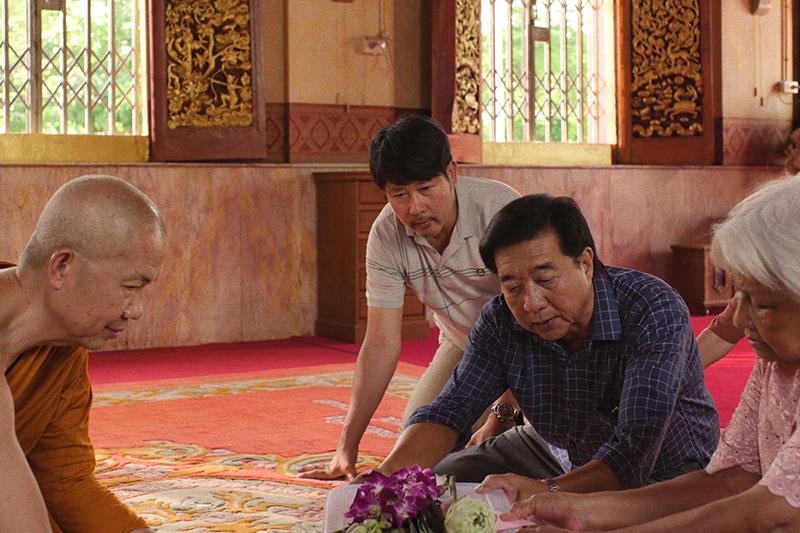
This is slow like real life. The film embraces an intense naturalism that we don’t often see in cinema. Eight middle-class Thai family members take their ailing grandmother around a series of Buddhist temples in the suburbs of Bangkok. They make offerings to the monks in each temple and in response they and the grandmother are blessed. The detail and nuance with which the family members interact is exceptionally engaging. Their experiences in each temple are markedly different and the changing ‘sides taken’ over the worth of their endeavour make the whole thing truly dramatic, almost Flaubertian. The patriarch of the family is being influenced by his own boss; the younger son thinks religion is a waste of time and money; the grandmother is tired and ill and, when asked, prefers to go home for a lie down. Such opinions and behaviours are the degree zero of life and it is great to see them presented and transfigured in cinema.
Sompot Chidgasornpongse has worked as assistant director to the great Thai master of slow cinema, Apichatpong Weerasethakul. This film is both more naturalistic, more dramatic and less mannered than Weerasethakul’s work.
Lê Bảo’s Hearing
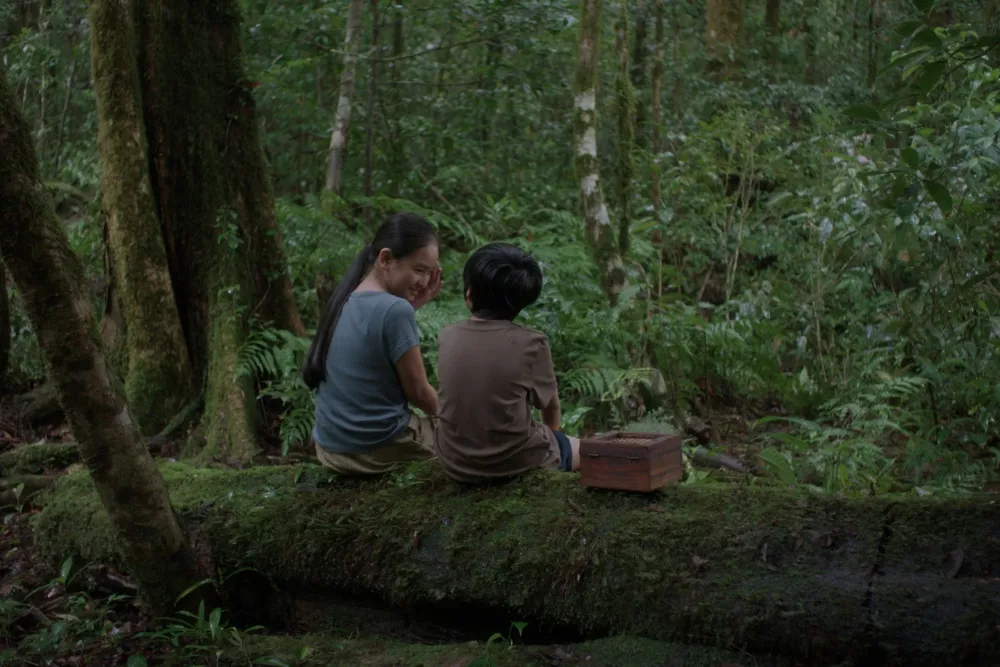
A much more oblique and enigmatic tale, Lê Bảo’s Hearing is formally slow. But the film uses its film form to make everyday life strange, beautiful and worthy of exploration. The main character, Ninh (Nguyễn Quốc Tuấn), is divorced, the primary carer for his aging mum and working as an installer of decibel reading equipment. The film follows Ninh as he works, sees his kids and tries to build bridges between his mum and his estranged, mushroom farming father – and between himself and his ex-wife and her new husband.
Whereas Lê Bảo’s first feature, Taste (2021) was set-bound and slightly claustrophobic, the spirit soars when Hearing opens out onto ravishing, durational images of nature and humans in nature. There are audaciously choreographed set pieces too, such as the opening scene in a rowdy restaurant, with Ninh hovering above all the chaos as he instals a decibel meter.
Lê Bảo is fond of long, well-framed fixed shots and non-expressive acting. Once you tune in to that, Hearing is absolutely riveting to watch.
Jing Zou’s A Girl Unknown
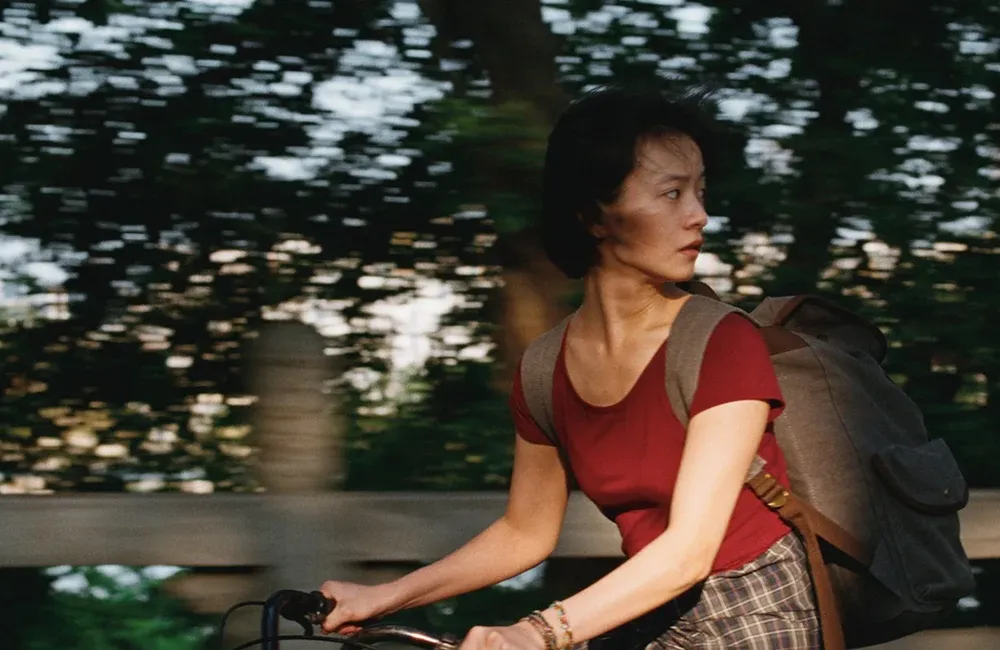
A slight derivation from the slow cinema ethic, this was the most emotionally satisfying film I saw at the festival. It tells the coming-of-age story of a six-year old girl (played by Cao Ruofan) as she grows into an 18-year-old [played by Li Gengxi, from Bi Gan’s Resurrection (2025)]. The girl moves through three families as she grows up, each of them giving her a new name.
Most of the adult carers “Juan” lives with are well-meaning (although male sexual predators make themselves known as she ages) but this kind of family situation entails tensions and conflicts that cannot be resolved.
It is pretty heartbreaking stuff: Juan goes from being a cute-as-a-button needy moppet whom you feel like hugging, to a sullen and damaged young woman. The tone is epic and reminded me of Jia Zhangke’s weighty histories of recent decades in Chinese history. Jing Zou’s film is more intimate; certain details stick with you. I keep thinking of the images of the playground outside her second family’s apartment: what should be a social space for children becomes a refuge and battlefield for Juan’s excluded personality.
A Girl Unknown is both emotionally satisfying and conceptually interesting. The film makes a good case for Juan’s refusal of the family ties projected onto her. It is perhaps a film in praise of anonymity, the choice to be anonymous, in a world that is intent on forcing identities on people.
Ryusuke Hamaguchi’s All of a Sudden
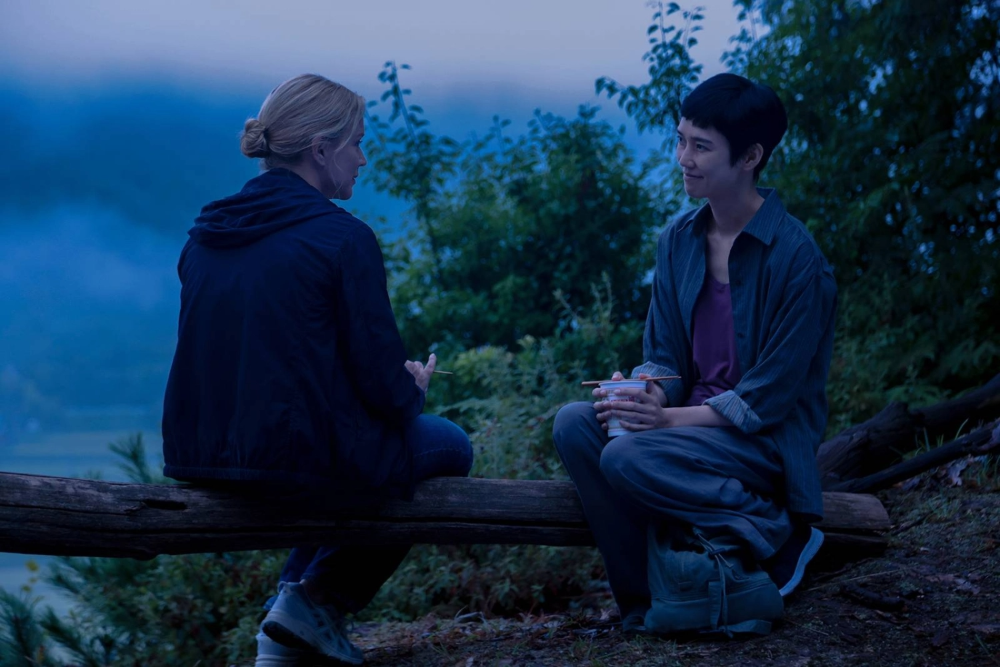
All of A Sudden is long, relatively slow and, at times, conceptually dense. Ryusuke Hamaguchi [Drive My Car (2021), Evil Does Not Exist (2023)] has always hidden his craft well, which fits with his general intention of mingling the prosaic, the practical and the profound. All of a Sudden succeeds in this better than the previous films. It is intriguing, high concept and utterly humane.
Marie-Lou, a private care home manager, played by Virginie Efira, strikes up a relationship with Japanese theatre director Mari, played by Tao Okamato. Marie-Lou rails at the money men who make it difficult to implement 37-minute personal care sessions for each patient in her home; Mari is coming to terms with her own mortality and trying to keep working when the money just isn’t there for international fringe theatre tours.
Important stuff is explored in this film. Real world dementia care issues meet a sort of crystal clear aestheticism in the telling. Notions of physical self-expression and performance are explored in real-time, almost Gurdjieffian or yogic displays of the physical practices deemed best for supporting declining mental faculties. Plus, there is a bizarre theoretical moment when Mari maps the effects of late capitalism on population growth on a whiteboard.
It sounds like hard work, especially when you factor in that a lot of the film is Marie-Lou and Mari just talking to each other – but All of a Sudden is an emotionally and intellectually stimulating watch. It feels like a manifesto of sorts for Hamaguchi’s approach, a manifesto that identifies what is important and under threat in our lifeworlds.
I am not saying that there weren’t a lot of other great films at the festival. I enjoyed:
- Manuela Martelli’s The Meltdown
- Arthur Harari’s The Unknown
- Stéphane Brizé’s A Good Little Soldier
- Jacqueline Lentzou’s A Day in the Life of Jo: Chapter Phaedra
I also recommend these films, either because they do what they do well or because they seem to bite off more than they can chew in an interesting manner.
My call out to the festival programmers is simply this: please give us a bit more slow cinema next year – it would be good for the souls of all festival-goers.




About the Author