Cast: Chow Yun-Fat, Ti Lung, Leslie Cheung, Dean Shek, Anita Mui, Tony Ka Fai Leung Review by Colin Dibben
A Better Tomorrow introduces money counterfeiter Ho (Ti), his cop brother Kit (Cheung) and his friend Mark (Chow). When a criminal deal brokered by Ho goes sour in Taiwan, he is imprisoned. Mark goes looking for revenge and ends up seriously wounded. Then their troubles really start: power plays in their organisation mean that they are now embarrassments to be cleaned off the board.
The second film sees Ho and Mark’s New York dwelling brother Ken (also played by Chow Yun-Fat) come to the assistance of Ho’s mentor Lung (Shek). The film moves from Hong Kong to New York and back again and contains several extended action sequences that need to be seen to be believed.
The third film is set a decade before the other films, during the Vietnam War. It provides Mark’s back story: it turns out that he got all his iconic moves from glamorous female intelligence agent Kit (Mui).
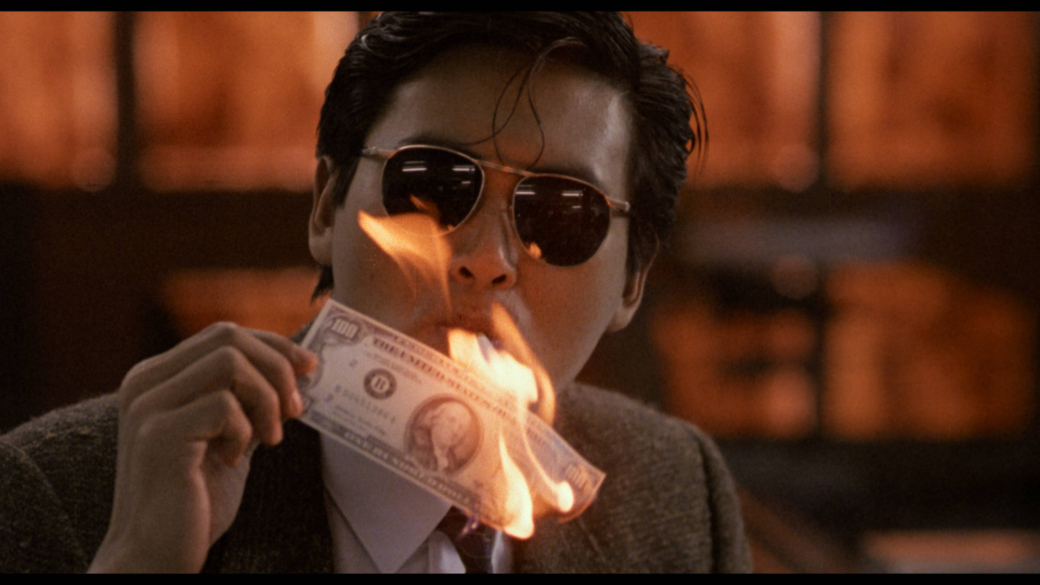
The first film was a massive success, creating the ‘heroic bloodshed’ genre in Hong Kong cinema, which explores notions of fraternal bonding within crime organisations. The film also gave cinema several iconic image elements: the dark overcoated hero with his sunnies on indoors and an automatic handgun in each hand, flies through the air while shooting endless bullets, his form silhouetted by an explosion behind him …
Both technically and emotionally, these films are all about the action sequences and the first two, directed by Woo, are deeply impressive in that regard. The second film was butchered in the edit – largely by producer Tsui – but Woo got to keep the outrageous, over-the-top action sequences that leave receptive audiences howling and giggling. The gaps in the storyline produced by keeping the action sequences intact are a price worth paying, however, and amusing in their own right.
As the extras point out, the trilogy maps the tense chemistry between producer-director Tsui Hark and director John Woo. Their different approaches to film style feed into this. Woo likes using more traditional movie sequences, where the action is set up and continually related to establishing shots – there are gliding tracking shots and slow-mo as well as tight close ups. Tsui is all about building action in the editing of a flurry of close up shots. For me, Tsui’s approach in the third film creates a zone of indistinction that is confusing to watch, whereas Woo’s approach is much more emotionally satisfying. Tsui is, on the other hand, probably the most important individual in the history of Hong Kong cinema in the 1980s and 1990s, for reasons that the extras explore.
The films look fabulous in both standard Blu-ray and 4K UHD editions and the packages come with lots of extras:
- Reversible sleeves featuring original and newly commissioned artwork for each film by Tony Stella
- Double-sided foldout poster featuring original and newly commissioned artwork by Tony Stella
- Collectors’ perfect-bound booklet featuring new writing on the films by critics and Hong Kong cinema experts Victor Fan, Camille Zaurin and David West, archival writing by critic Julien Dupuy and an excerpt from an interview with John Woo conducted by Stéphane Moïssakis
- Brand new interviews with director John Woo, producer Terence Chang, writers Chan Hing-Ka and Gordon Chan, filmmaker Gareth Evans and author Grady Hendrix
- Brand new audio commentaries by Hong Kong cinema experts Frank Djeng and FJ DeSanto and film critic James Mudge
- High Definition Blu-ray presentation of the recently unearthed extended Workprint Cut of A Better Tomorrow 2, viewable either in raw unrestored form or with inserts from the restored Theatrical Cut, via seamless branching
- High Definition (1080p) Blu-ray presentation of the extended Taiwanese preview cut of A Better Tomorrow 3
The A Better Tomorrow Trilogy is out from Arrow Video on 28 September 2026, in separate standard Blu-ray and 4K UHD box sets.




About the Author