
Dir: Olivier Assayas, France/United States, 2025, 137 mins
Cast: Paul Dano, Jude Law, Will Keen, Jeffrey Wright, Alicia Vikander
Review by Carol Allen
In the film and book he is fictional presidential adviser Vadim Baranov, who is based on the man who took that role in real life, one Vladislav Surkov.
The story gets underway with the presidency of Boris Yelstin after Glasnost, with Moscow’s young people in party mood. For young Baranov (Paul Dano), his girlfriend Ksenia (Alicia Vikander) and young oligarch Dmitri Sidorov (Tom Sturridge), who is getting filthy rich by the moment, the champagne is flowing and the partying rivalling the orgies of Caligula. Baranov, an avant garde theatre producer and later a reality tv producer then meets media tycoon Boris Berezovsky (Will Keen), who has the drunken president pretty much in his pocket.
Berezovsky realises there will be a power gap when Yelstin goes and he recruits Baranov to help him get the right man, a puppet he has chosen for the job – a civil servant and head of the FSB security service. But Vladimir Putin (Jude Law) is no puppet. It very soon becomes clear that what he wants is not money but power – and the days of the oligarch’s running the show are over. While the man who helps him to manipulate his way into that power is Baranov, the wizard of the Kremlin.
It all makes for an interesting two and a quarter hour summary of Russian history. The story is framed by the now retired Baranov telling his story to American journalist Rowland (Jeffrey Wright), which makes for a lot of voice over but without that the film would probably rival the length of Dr Zhivago. Dano moves convincingly from enthusiastic youth to bland calm with a manipulative brain plotting underneath.
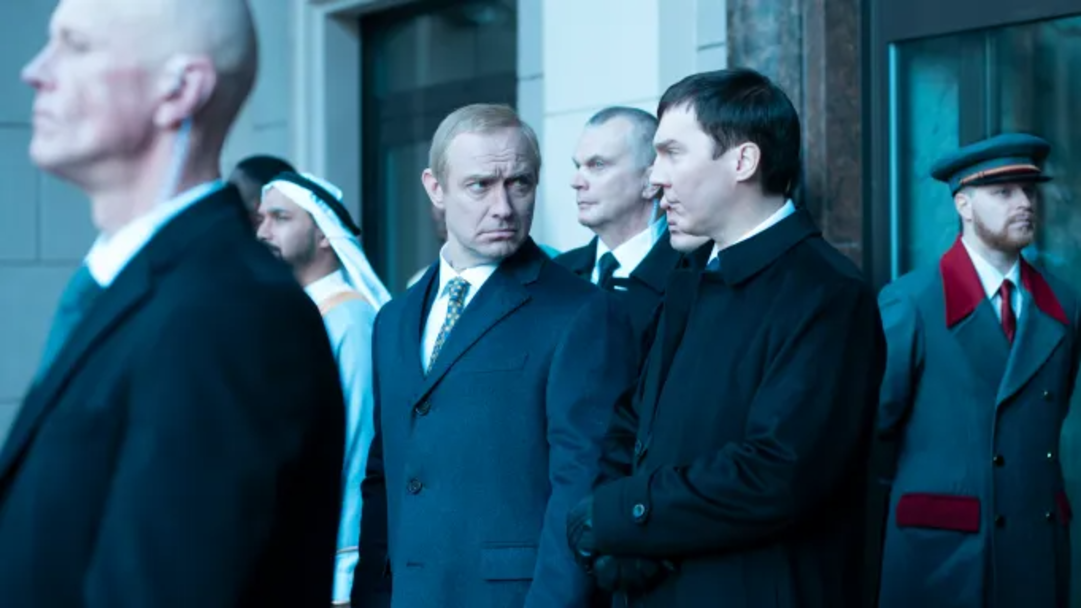
Particularly good is Will Keen as Berezovsky, who has an uncanny resemblance to the late Robert Duvall. When he and Baranov are plotting strategy together, they sometimes look like they could be part of the political team in the White House. Law as Putin, playing the best known face in the cast, is eerily convincing. From the combover of the then younger man to the occasional chilly smile, he gives not only a convincing physical similarity – Law is almost unrecognizable – but captures the icy and iron grip of the man as well.
The film is sometimes a bit heavy going, particularly if you’re not up on recent Russian history, though there is the occasional flash of humour to lighten it – one memorable moment being when Yelstin, about to do a telly broadcast, is so drunk he has to be tied to his seat to keep him upright.
Some rather more specific chapter headings than the ones given, with date and event rather than a poetic phrase, might have been helpful. But the film is still a useful and timely dramatized summary of an important piece of contemporary history. And I’m now rather keen to read the novel




About the Author