Cast: Gianna Jun, Koo Kyo-hwan, Ji Chang-wook, Shin Hyun-been, Kim Shin-rock, Go Soo Review by Colin Dibben
Colony is less original than Busan, with George A Romero’s Dawn of the Dead and Day of the Dead in its DNA, but for tense thrills, well-choreographed action sequences and plot-driven suspense it is hard to think of many better made zombie – even horror or action – films in the last decade
A biotech firm uses a conference at their prestigious corporate HQ in central Seoul to bring more investors onboard. Resentful, maverick researcher Suh Young-chul (Koo) injects himself with what appears to be the antidote to a virus with which he then infects the company’s CEO
The virus – it hardly needs saying – turns people in the tower block and its adjacent shopping mall into rabid, biting beasts that run on all fours. But Suh’s research was into the communication found in mycelium networks such as fungi: his virus creates a ‘hive mind’ in the zombies, allowing them to learn from each other and evolve into what Suh deems “the next stage of humanity
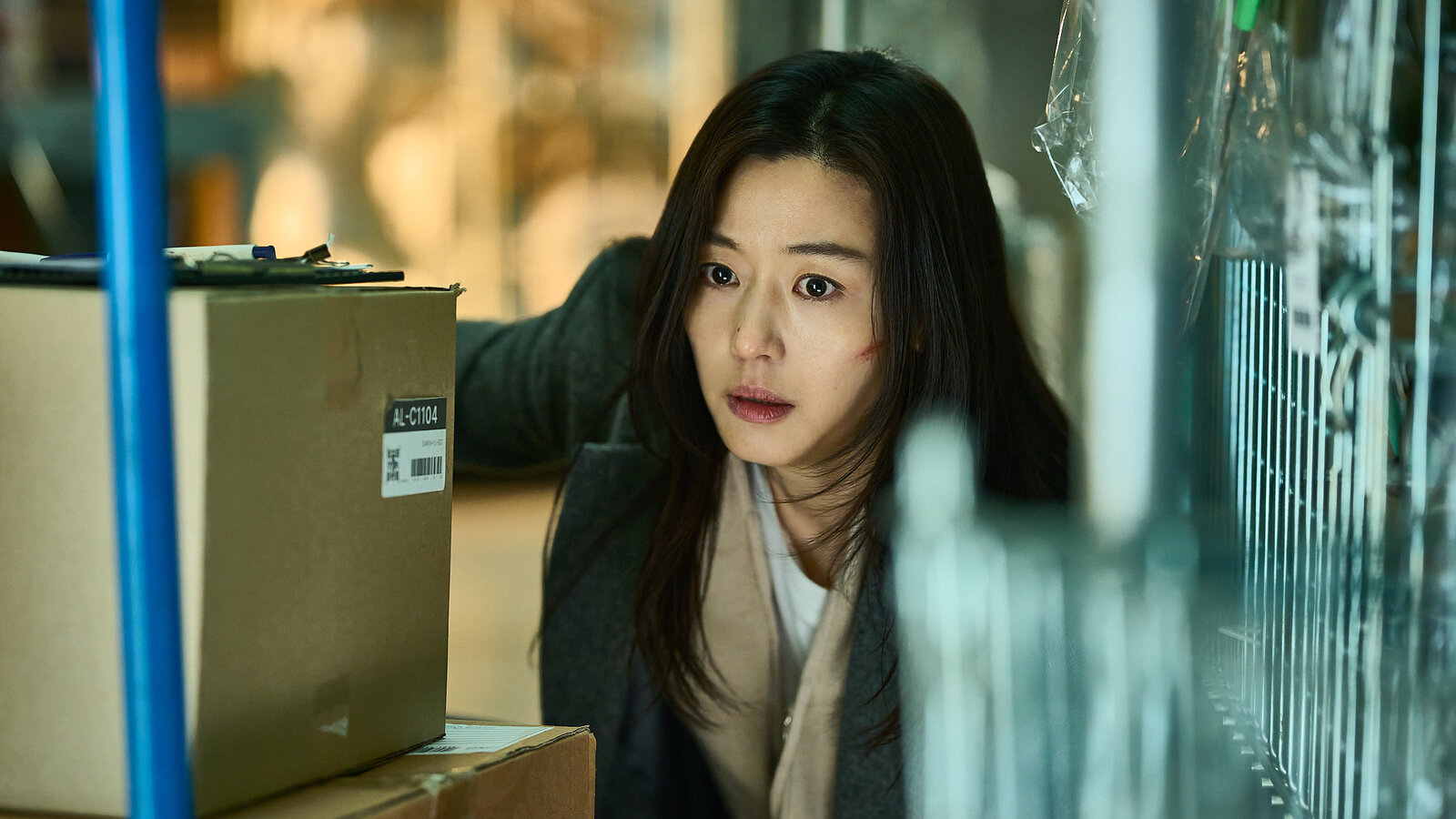
At outbreak, there is another maverick scientist in the building: Professor Kwon Se-jeong (Jun), the ex-wife of one of the biotech company’s administrators. When the police and army lockdown the building, Kwon is soon leading a small group of survivors to dodge zombies, find Suh and escort him to a rooftop escape team.
Meanwhile, outside the HQ, the administrator’s current wife, yet another egghead, Professor Gong Sul-hee (Shin), is helping the authorities get to grips with what is going on. A visit to Suh’s rural research lab suggests several options – but is there time to find the right one before the zombies escape lockdown and infect the city?
You often hear people say that they liked Train to Busan even though they do not like zombie movies. I say it a lot, for one. Colony works for the same reason that Busan did: there is direct, immediate correlation between tension and suspense and the narrative situation as it develops and changes in interesting and carefully constructed directions.
In Colony, the situation is not only the series of now-threatening prosaic spaces that the survivors have to scurry through – shopping mall units, office corridors, parking lots – real sets and locations, all carefully engineered for effect by production designer Lee Mok-Won
The situation is also the zombies’ evolution. Their hive mind means that they are constantly ‘upgrading’ their knowledge of the world around them and what the survivors are doing. It is a bit like a role-playing game with a traitor role, or a crime film in which the villains always know what the good guys are doing.
As the situation develops, the survivors analyse their ongoing, changing predicament and come up with possible solutions that they then act on. They, like the zombies, are almost always on the move. The frenetic pace of the action and its editing – both inside and outside the tower block – is impressive.
Choreographer Jeon Young used professional dancers to create new movements for the zombies that reflect their evolving nature. We see them twisting spastically, crawling on all fours, staggering to the upright position, engaging in a bit of body melt and even eerily mimicking the survivors. A shot of zombies frozen in place honours the dancers’ very physical presence and fits with the ‘realism’ of the whole film, in that minimal use was made of CGI and the actors’ character traits are given plenty of screentime to show.
Colony goes a very long way to dispel the wrong step of the Busan sequels, especially Peninsula. Even if you don’t usually like zombie films, there is joy to be had in watching a tightly made, thrilling action film with threat and plot curveballs a-plenty. There isn’t even that much gore, although slime takes its place.
Colony will be available to buy & keep on digital platforms and on DVD, Blu-ray & 4K UHD from 28th September




About the Author