
Many consider David Cronenberg’s films to be unparalleled in their depiction of human physiology taken violently beyond its limitations. Yet the varied physical unpleasantries populating his movies are superficial horrors, and the shivers they induce barely run skin-deep. Cronenberg’s preoccupation with the flesh is not simply akin to the axe murderer’s mania, nor even the surgeon’s razor-edged quizzicality; rather, his dermal manipulations are the work of a sculptor trying to expose the skull beneath the skin. With an obsession bordering on monomania, he returns again and again to the same philosophical concerns: the Cartesian nightmare of a unified mind/body duality; the categorical uncertainities of biomechanics; and obove all, the instability of the self.
Born in Toronto to a journalist father and pianist mother, a young Cronenberg wrote brooding, cerebral works of SF and fantasy, which he submitted (unsuccessfully) to magazines for publication. Enrolling as an English major at the University of Toronto in 1965, he became interested in taking part in the burgeoning student filmmaking scene. The young, would-be filmmaker struck up a friendship with a young Ivan Reitman (who would become a successful Hollywood producer-director a few years after producing Cronenberg’s first commercial feature), and established a deal with a local camera-rental service who would provide him with equipment. Learning his technical craft by voraciously consuming cinematographer journals, he produced his first two films in mid-1966 and 1967: a seven minute experimental work shot in colour on 16mm, entitled Transfer ; and a fourteen minute, colour short with the enticing title, From the Drain .

Although neither short made much of an impression at the various student festivals where they were screened, Cronenberg persevered, and by 1969, he produced his first feature film Stereo , shot in 35mm and black and white. The film is about experimentation on telepathic subjects, and introduces his familiar obsessions with the tyranny of medical science and corporate control of technology coupled with the vulnerability of the body and the intersection of technology and sex. Stereo was largely financed by a Canada Council writing grant and was extremely well received at festivals throughout the country and abroad. It attracted the favourable attention of the Canadian Film Development Centre, which allowed Cronenberg to successfully apply for a grant to make his second feature film, Crimes of the Future , another 65 minute film. In this second feature, a mysterious disease has ravaged a future society causing a secretion to ooze from the orifices of its victims – a secretion that attracts others to smell and lick it. Meanwhile, its alienated hero strives to develop “a novel sexuality.and a new form of biochemistry” in order to bypass its effects.
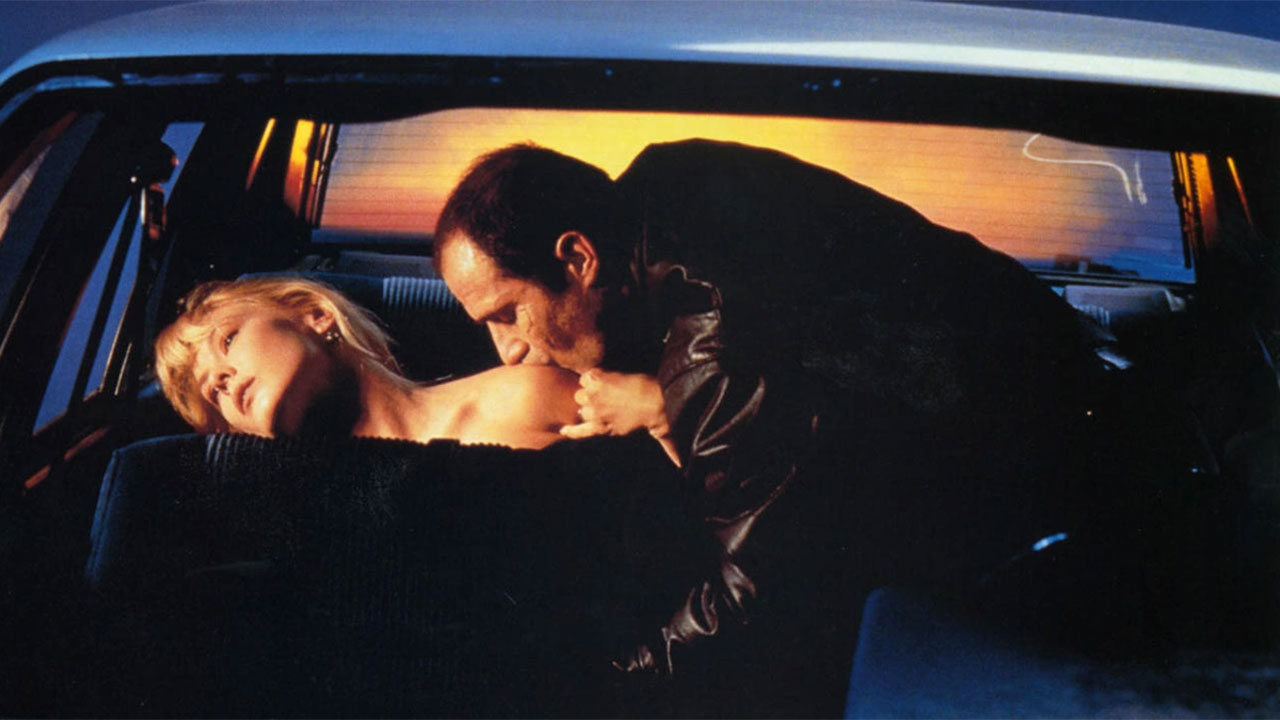
The strength of these first two features landed Cronenberg fairly steady work afterwards producing television fillers for the Canadian Broadcasting Corporation for the next two years. Moving to France for a year in 1972, he began to work on his first commercial release, Shivers , a film set in Montréal about a parasite that turns its victims into sex-zombies (interestingly, Cronenberg would direct a more allegorical film about a different breed of sex-zombies twenty years later: the auto-erotic essay on technocarnality, Crash ). The film took over two years to finally secure financing due to its gruesome subject matter. Upon its release in 1976, Shivers bore the brunt of the most heated critical outrage from Canadian film critics in decades. The vehemence with which the film was attacked was not so much prompted by its explicitness and visceral content as it was by a lack of any distinct “Canadian themes” ( Shivers was largely sponsored by the government-controlled CFDC), and its rejection of the social realist aesthetic that dominated Canadian cinema at the time. Yet despite critical outrage (or, perhaps because of its critical notoriety), Shivers achieved unprecedented success at the box office, becoming the highest grossing feature in Canadian history to date. Making over five million US dollars worldwide, Shivers is still one of the fastest recouping Canadian films of all time – an honour dubiously shared with a sex film of a very different sort: the crass T&A comedy, Porky ‘s.

For whatever reason, the film’s bleak carnival of sex-crazed zombies storming an apartment complex struck a chord with audiences. The success of Shivers allowed Cronenberg to work with an increased budget for his next film, Rabid , which was released the following year and which also enjoyed substantial commercial success. The film is about a woman cursed with a prehensile organ that juts from her armpit and causes rabies, and stars former porn queen, Marilyn Chambers. Cannily drawing on such exploitation fare, Cronenberg was able to develop further his preoccupations with sex, viral pathology, and the mounting transgressions of medical science in the name of “progress.” Indeed, Rabid ‘s depiction of social hysteria in the midst of a rapidly spreading contagion achieved an even greater resonance following the traumatic entry of AIDS into the public consciousness during the 1980’s. With its final shot of the female protagonist’s corpse being stuffed into a garbage compactor, Rabid is easily the bleakest of Cronenberg’s films.
If Rabid marked the apex of Cronenberg’s early pathological forays, then his next horror film would trace out the beginnings of a new kind of dis-ease in his thematics. Following the production of the completely aberrant Fast Company in 1979 – a quick-buck potboiler about drag racing – he directed The Brood , his first film with a full-scale budget and international stars. A nightmare tale of psychosomatic therapy gone terribly awry, this would be the first of Cronenberg’s works to supplement the horrors of physical instability with the even more profound terrors of psychological breakdown. When the onset of a woman’s anger triggers her to autogenetically spawn deformed and murderous offspring, her estranged husband is forced to throttle her to prevent her from indirectly killing their innocent daughter. While Cronenberg describes the film as “my Kramer vs. Kramer ” (its allegory of domestic breakdown was influenced by his own messy divorce), The Brood is not simply horror-infused melodrama; the film articulates our culture’s unspoken, but profound fear of the unruly body.

Partially wrought from the paternalist uneasiness with the maternal body, the central character’s monstrous externalised womb is the corporeal manifestation of categorical breakdown. Nola’s body blurs distinctions between inside and outside, her sexless brood are neither male nor female, and the lesions on her skin are the physical manifestations of psychic rage. While the unconscious imperative of horror films has always been the violation of such fundamental conceptual binaries, The Brood savages these dualisms with surprising, deliberate sophistication. Previously dismissive critics began to pay attention, and although Cronenberg retained more than his fair share of detractors (the influential Robin Wood being the most vociferous among them), this was to be the first of his films to win widespread critical acclaim.
With the artistic breakthrough of The Brood , Cronenberg had emerged as a director of considerable sophistication and stylistic bravura. All of his subsequent features (with the exception of the hastily-produced Scanners in 1981) contain moments of exquisite, terrible beauty, bringing considerable gravity to the oft-denigrated genres of horror and science fiction. Clearly, Cronenberg has benefited from working with larger budgets. Major studio support has brought a much-needed polish to his work and has allowed him to explore increasingly more spectacular territories. Although the crudity and sloppiness of Scanners marked an aesthetic step backwards, its box office performance in 1981 (opening at an unprecedented number one in North America , according to Variety) attracted the attention of Universal executives.
Videodrome was made for and distributed by Universal in 1983 and represented his finest work to date. Andy Warhol hailed it as “the Clockwork Orange of the ’80’s” – its iconoclastic fusions of sex and cybernetics no doubt appealing to the bewigged artist who had once expressed his desire to be a machine. Graphic, disturbing, and strangely erotic, the film’s sado-masochistic intermingling of man and machine is a long way from the mannered politesse of Universal’s gory glory days of horror in the 1930’s. James Whale alone might have been perversely tickled.

The intersection of flesh and technology in Videodrome would be a motif repeated by Cronenberg again and again, achieving its culmination in the mechanistic, Warholian orgy that is Crash (a film that did not simply curb the enthusiasm of Cronenberg’s popular fan base, but sent it spiralling headlong into a ditch). As Videodrome ‘s central character, Max Renn is drawn further and further into a violent, televisual sexuality, he undergoes a series of ecstatic violations by eroticised machinery. This biomechanical marriage is the first of many subsequent unions.
Such amalgamations have transformative effects on the films’ characters, articulated through the blossoming of a new sexuality which incorporates the spectacle of death with the spectacle of technology. Max’s fantasies about sex with his television lead to a suicidal metamorphosis. Twin gynaecologists create instruments to “operate on mutant women” in Dead Ringers , only to eventually turn the surgical tools on each other. Insects, machinery, and sexual organs achieve monstrous, carnal hybridity in both The Fly and Naked Lunch . Characters experience the ultimate technological penetration in the auto wrecks of Crash , and “jack in” to their organic gaming units via a cord inserted into their navel in eXistenZ . Thus, Videodrome marks the beginning of an uncertain polemic that Cronenberg continues to straddle.

Critics are divided as to whether his films condemn or celebrate the technologised and necrophilic sexuality he so often represents. Is the intersection of technology and the body in his films depicted as a generative matrix in which a new eroticism develops? Or, does it represent nothing more than nullifying pornography, emulative of a fatalistic, cybernetic ennui?
And yet, the physical uncertainties and corporeal ambiguities in his work are only the tip of the iceberg – surface horrors, so to speak. The real mindfucks are just those: the tremors in the characters’ (and our) conception of what constitutes the real; the metaphorical carpet being pulled from beneath grounded feet; the testing of the empirical world itself. Since the separation anxiety of Dead Ringers in 1988, in which twin brothers degenerate into psychosis after failing to individuate themselves, Cronenberg’s films have increasingly concerned themselves with psychological dilemmas. Or, more precisely, the insecurities of the mind surface as insecurities of the body. Taking on the cold formalism and narrative meanderings of classic European art cinema (exemplified by Antonioni’s and Bertolucci’s work in the late sixties and early seventies), his later work achieves a strange marriage of body horror and existential psychodrama. Dead Ringers and M. Butterfly trouble easy notions of self-identity.

Naked Lunch and Crash employ extreme forms of sexuality as a remedy for (or perhaps a symptom of) the tedium of everyday living. eXistenZ riffs on Videodrome ‘s panic over our increasingly mediated – one might even say, virtual – reality. True to the weltanschauung of their art cinema progenitors, the mindscapes of these films are often disquietingly beautiful, but are wastelands nonetheless. As Robin Wood complains of Cronenberg, “the world of his films is not only a world without joy, it is a world in which there is no potential for joy. The films lack any sense of the tragic: nothing of value is lost, because nothing has value.”
While it is questionable that the awful denouements of films such as The Fly and Dead Ringers are void of tragic resonance, Cronenberg’s films occasionally flirt with an eroticised nihilism. They do not so much suggest a world that is meaningless as they point out the irreparable flaws in the foundations upon which meaning is constructed. Passionless sex is the ultimate preoccupation of nearly all of his films, as it represents the repetitious and mechanistic motions of living ritualistically in a world bereft of symbolic anchorage. Antonioni spoke of trying to represent the “death of eros” in his work. Cronenberg has reanimated the corpse – depicting contemporary life as a Frankensteinian horror, a living death.

In Cronenberg’s latest film, Spider , Ralph Fiennes’ lonely schizophrenic is one such zombie, cut adrift in an undead landscape. Re-entering society after a long period of isolation in a mental institution, Spider returns to his childhood haunts in London . But our damaged hero has not lived the charmed life of your typical Eastender (no jaunts down to the Queen Vic for the simple pleasures of a drunken row with a wonky-eyed Kat); Spider is sent mumbling to the nuthouse after a series of events involving the death of his mother (Miranda Richardson). Believing that his father, Bill Cleg (Gabriel Byrne) has murdered her in order to replace her with a prostitute, Yvonne (also Miranda Richardson, in a Lynchian, or should I say Freudian, twist), a young Spider decides to take action. The traumatic results send him headlong into a world of delusion and paranoia (come to think of it, it does sound like the charmed life of your typical Eastender). Returning to his old neighbourhood only makes matters worse, for the decrepit environment reawakens long-repressed memories and he begins to confuse his present landlady (Lynn Redgrave) with the hated Yvonne. As it gradually becomes apparent that we cannot trust Spider’s memories, we find ourselves in familiar unsettling territory: this is another Cronenberg fever dream, in which reality is subject to the same permutations as the unstable flesh.

Spider , one of his most recent fims, is a variation on the director’s unnerving theme: reality as labyrinth, memory as shape-shifting minotaur. Like the protagonist-cum-victims in Videodrome and eXistenZ , Spider is webbed within a Möbius strip from which he cannot escape, a cyclical nightmare that winds back upon itself in dizzying narrative loops. Unlike the technologically driven televisual and virtual fantasies in those films, however, this is a perpetual-motion machine of Spider’s own devising. The construction and subsequent demolition of the character’s twisted memory palace is depicted with a clinical vividness that rivals – surpasses even – any of Cronenberg’s previous efforts. Extremely well-received on the festival circuit, the film has already won a Genie for best Canadian feature of 2002 and has earned him the prize for Best Director at Cannes in 2002.
Yet despite the typically dispassionate eye of its director (the gaze of the scientist-god at the subjects in his Petri dish), Spider is one of Cronenberg’s most emotionally engaging works – perhaps due to its high level of subjectivity. In seeing the world through the eyes of the shattered central character, we are at last allowed a degree of empathy for the human wreckage that masquerade as individuals in Cronenberg’s cinema. For this perspective emulates a captivating spider-sense: a prismatic vision that fractures the quotidian and yet remains enthralling because of its residual connection to the familiar. Why another tale of angels and insects? Why another Cronenbergian version of a Bug’s Life? “It’s the traditional metaphorical use of the web as something that ensnares you but that is also beautiful,” he explains, “and that you can weave one of your own, as well as being caught in somebody’s else’s.”

With his latest release A History of Violence, Cronenberg travels deeper into the realm of seeming normality with his most human and mainstream characters thus far, allowing the audience a greater sense of surrealism as, with characters more readily identifiable to themselves, they join in the journey that plunges them into the blurring of boundaries between the real and unreal as the director draws us ever more tightly into his weird and wonderful web.
Aaron Taylor




About the Author